
Farmers MarketsGuide
Signage and Price Cards: The Small Details That Move Product at a Market Table
A shopper who cannot find a price often walks instead of asking. What the three signs every booth needs should say, how big the letters have to be, what survives weather, and the point-of-sale placards some states require by law.
 United Farmers Market Editorial Team
In this guide
- Three signs, in the order a shopper needs them
- Why an unpriced item is an item you did not really offer
- How big the letters have to be
- Chalk, print, or both
- The unit on the card is not always your choice
- The line under the name, and the line about allergens
- The signs your state may require by law
- The ten-minute check before you leave the driveway
A shopper picks up a jar of pepper jelly, turns it over twice looking for a number, and puts it back. You were four feet away with your back turned, bagging someone else's tomatoes. You will never know it happened.
University of Tennessee Extension's merchandising bulletin for direct farm marketers, PB1794, puts it flatly: "A sales display without proper signage is just a display, because there are typically few sales." Shoppers are used to seeing prices in a retail setting and mostly will not ask for one; many "will do without the product rather than ask." A missing price reads either as too expensive or as a seller who is not credible.
Signs are the cheapest fix in a booth, and the one most vendors put off.
Three signs, in the order a shopper needs them
Washington State University's Sell More! vendor booth guide sorts booth signage into three jobs: price signs, product signs, banners. They answer three questions as a shopper closes the distance: who is this, what is that, what does it cost.
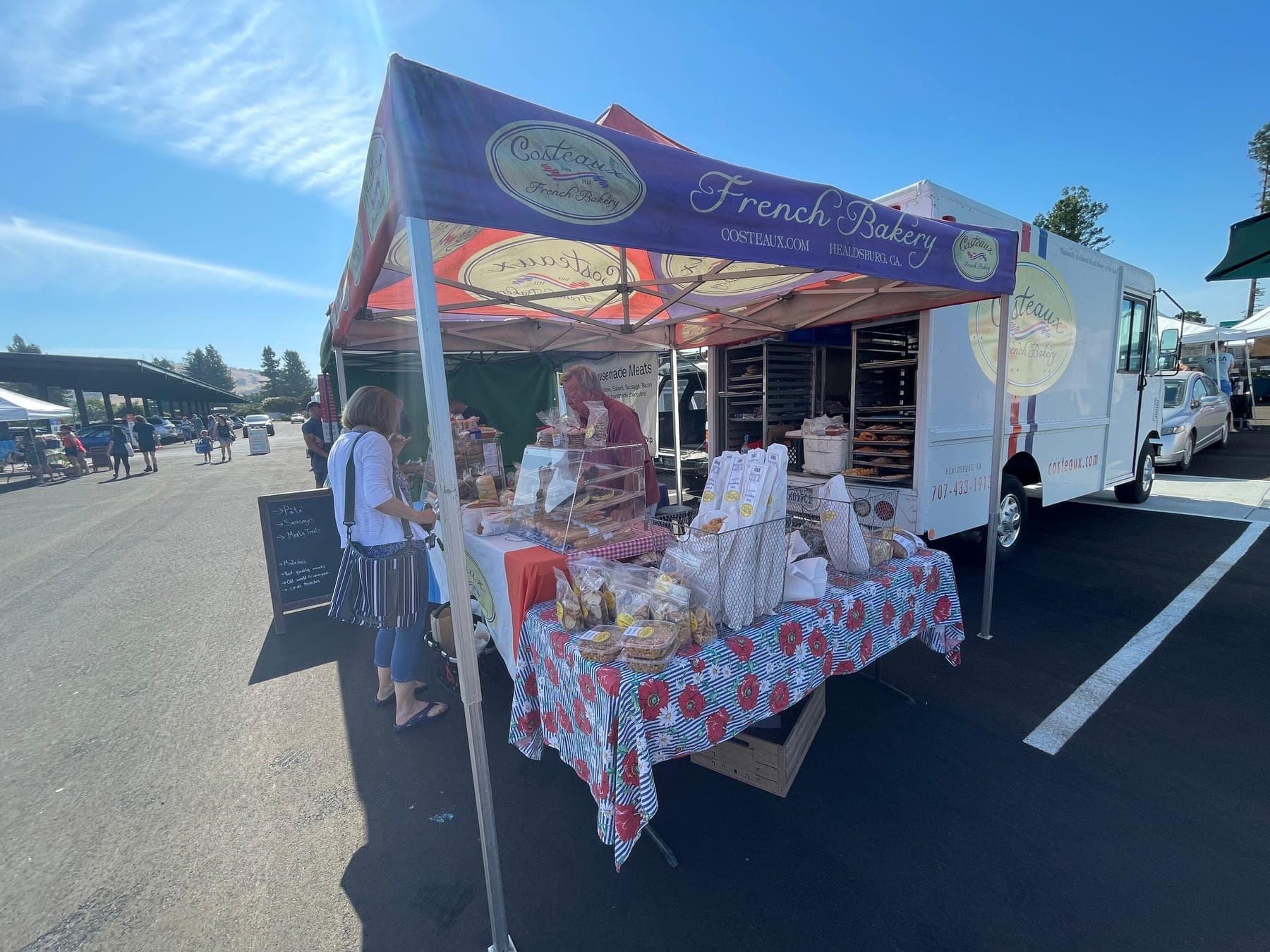
The banner is the one most vendors get wrong, and PB1794 says why. Vendors often affix the farm name to the table front, where the people standing at it block the view. Put it above head level, behind the table or across the front of the canopy. The Sell More! banner sheet adds a harder discipline: fewest words, most important thing biggest, because most people give a banner one glance. Business name, town or growing region, a logo if you have one. Our guide to naming and branding a home food business covers the choices that end up on that banner for years.
Product signs and price cards are often one card, fine so long as it sits with the item and angles toward the aisle instead of lying flat.
Why an unpriced item is an item you did not really offer
At some markets a posted price is a rule rather than a courtesy. Texas Charter Township, outside Kalamazoo, Michigan, requires in its 2025 vendor rules a sign identifying the name and location of the business, and that "prices must be clearly posted for each product in a place visible to TTFM patrons." A third violation of any rule there means suspension. Check your own market's handbook.
The Sell More! basic market-day checklist is a faster diagnostic. Two of its ten questions: "Can customers easily see what products cost?" and "Do customers know what their payment options are without talking to anyone at your booth?" The second is its own small sign, posted where people pay. Texas Charter Township also requires vendors enrolled in SNAP, Double Up Food Bucks, or Senior Market FRESH to post signage for the programs they take, covered in our guide to accepting payments at farmers markets.
How big the letters have to be
Penn State Extension's product signage guidance gives a blunt test for table-level signs: if it cannot be read from 8 to 10 feet away, it is too small. For anything read from farther off, Penn State's roadside signage bulletin cites the International Sign Association rule of thumb, one inch of letter height per 25 feet of reading distance.
That rule is a floor, and it assumes a reader already looking. Only the third column below comes from a source; the fourth is where we round up.
| Sign | Read from | ISA minimum | Round up to |
|---|---|---|---|
| Business name, above head height | 25 to 30 feet | 1 to 1.5 in | 3 in or taller |
| Product or category sign, angled at table height | 6 to 10 feet | under 1 in | 1.5 to 2 in |
| Price card, sitting with the item | 3 feet | under 1 in | 1 in |
Contrast decides legibility as much as size does. PB1794's checklist: dark lettering on a light background, a plain font (script and italics are pretty and hard to read), Capitalization Of Each Word rather than all caps. Sell More! names the three easiest combinations as black on white, yellow on black, and white on blue, and notes cursive is harder to read than print, serif harder than sans-serif. Penn State puts a sign's whole message at five to seven words.
Chalk, print, or both
PB1794 lists the workable materials: paper, card stock, chalkboards, dry erase boards. Chalk and dry erase pens make changes simple, and lamination protects card stock from water while still taking a grease pen. Penn State adds rigid backers and says to replace weather-damaged signs promptly, the easiest rule to skip. A sun-bleached, rain-warped price card says something you did not intend.
What holds up over a season is two sets. Print what never changes (name, standard line, allergen statement, payment types) on laminated card or coroplast. Keep the weekly items (this price, this variety, "last two dozen") on small chalkboards or laminated blanks, mounted the way PB1794 suggests: dowels, floral stakes, clothespins, or tape.
Two things the bulletins leave out. Chalk pen smears on a damp morning, so write the night before and let it dry. And any sign taller than the product behind it is a sail; see farmers market weather preparation.
The unit on the card is not always your choice
Price cards carry a unit, and for fresh produce the unit can be regulated. Farmers market weights and measures guidance from the Iowa Department of Agriculture and Land Stewardship includes a method-of-sale table: which commodities may be sold by weight, count, head or bunch, or dry measure. Avocados go by count. Corn on the cob goes by count or by dry measure of a quart or larger, not by weight. Berries go by weight or dry measure. That table is Iowa's, resting on the NIST handbooks it cites. Your state writes its own, so check before you print "per pound" on anything.
If you sell by weight, the scale is regulated too. Iowa licenses only National Type Evaluation Program certified scales, annually, expiring December 31, and names bathroom and kitchen scales among those not legal for trade. California requires a type-approved scale tested and sealed by the county sealer before first use and annually after, per the Nevada County Agricultural Commissioner. For what the number on the card should be, see our pricing guide.
The line under the name, and the line about allergens
A card that says only "Jam, $8" leaves money on the table. Penn State's examples are the right length and kind: "tree-ripened peaches," "great for pies, holds shape well," "use within 3 days for peak flavor." PB1794 lists the same categories: characteristics, best use, complementary products, the special of the week. Sell More! supplies the discipline: select the most important information, then stop.
Allergens are a separate line and a serious one. U.S. law recognizes nine major food allergens, sesame having become the ninth on January 1, 2023 under the FASTER Act. Packaged product carries it on the label, as our cottage food labeling guide lays out. For a bulk display, a cut-cake case, or a sampling plate, put a plain card where the shopper reaches: which of the nine are in each item, and what else is made in the same kitchen.
The signs your state may require by law
Several states require a sign at the point of sale, with wording you do not get to improve.
- Minnesota. Statute 28A.152, subdivision 1 requires a seller of exempt homemade food to display at the point of sale "a clearly legible sign or placard stating: 'These products are homemade and not subject to state inspection.'" Subdivision 2(d) puts the same sentence on any website that offers those foods.
- Illinois. The Illinois Department of Public Health's cottage food guide requires notice at the point of sale, as a placard at a physical display and as a message on the online sales interface: "This product was produced in a home kitchen, not inspected by a health department, that may also process common food allergens." The FAQ sets the physical minimum at 8 inches by 10 inches.
- Texas. DSHS puts the capitalized disclosure statement on the label. The sign version falls on a "cottage food vendor," someone selling a producer's food under contract on that producer's behalf, who must display the disclosure "in a prominent place near the location where the food is offered for sale."
- California. The direct marketing rules for certified farmers markets (Food and Agricultural Code 47004 and 3 CCR 1392.4) require a producer to post a conspicuous sign or banner with the farm or ranch name, the county of production, and a statement that they only sell what they grow "or similar representation," alongside the certified producer's certificate in full view.
The ten-minute check before you leave the driveway
Lay the signs on the tailgate and ask: Is the business name legible from across the driveway? Does every product have a price, in a unit you are allowed to use? Is the placard in the box? Is there a card naming the payments you take? Are there blank cards and a working marker, so "SOLD OUT, back next Saturday" goes up instead of a gap that reads as packing early?
Then stand where a shopper stands and read your own table. That exercise, and the display around it, is our booth display guide.
Sources and further reading
- 1.Making the Most of the Market: Merchandising Considerations for Direct Farm Marketers (PB1794, November 2010) · University of Tennessee Extension, Center for Profitable Agriculture · accessed Sep 2, 2026 · Quoted: a sales display without proper signage 'is just a display, because there are typically few sales.' Also: customers often will not ask a price and may read a missing one as too expensive or the seller as not credible; farm name above head level, not on the table front; dark lettering, plain fonts, Capitalization of Each Word; card stock, chalkboard, lamination, dowels and floral stakes
- 2.Product Signage That Sells: Best Practices for Farm Markets · Penn State Extension (Brian F. Moyer), updated March 27, 2026 · accessed Sep 2, 2026 · The 10-foot rule ('if it can't be read from 8-10 feet away, it's too small'); 5 to 7 words ideal; clean sans-serif fonts and high-contrast colors; laminated signs or rigid backers; position at eye level or angled; replace weather-damaged signs promptly; the quoted sign examples about tree-ripened peaches, pies, and 3 days for peak flavor.
- 3.Roadside Signage for Farm and Agritourism Operations · Penn State Extension, updated September 4, 2025 · accessed Sep 2, 2026 · International Sign Association rule of thumb: one inch of letter height for 25 feet of reading distance; sans-serif and non-script fonts; negative space; material color fastness under weather
- 4.Sell More! Farmers Market Vendor Booth Guide (2014, Version 1.0) · Washington State University Small Farms Program, hosted by the Farmers Market Coalition · accessed Sep 2, 2026 · Page 9 lists three sign types (price, product, banners) and the rule to select the most important information; page 2 is the ten-question basic market-day checklist including questions 3 and 9; pages 11-12 are the banner tip sheet on fewest words, biggest most important information, black on white, yellow on black, white on blue, and cursive and serif being harder to read
- 5.Farmers Markets: Iowa Weights and Measures Regulations · Iowa Department of Agriculture and Land Stewardship · accessed Sep 2, 2026 · Method of sale table (avocado by count; corn on the cob by count or dry measure of 1 quart or larger; berries by weight or dry measure); NTEP certification required, bathroom and kitchen scales named not legal for trade, licenses expiring December 31; packaged goods in letters not less than eight-point heavy gothic caps with distinct contrast; NIST handbooks named as the underlying standard
- 6.Certified Producer's Certificate Information (v2023) · Nevada County Agricultural Commissioner's Office, California · accessed Sep 2, 2026 · Summarized conditions of direct marketing sales under FAC 47004 and 3 CCR 1392.4: conspicuous sign or banner with farm or ranch name, county of production, and a statement that they only sell what they grow or similar representation; certificate displayed in full view; type-approved scale tested and sealed by a County Sealer before first use and annually
- 7.Minnesota Statutes § 28A.152, Cottage foods exemption · Minnesota Office of the Revisor of Statutes (2025 Minnesota Statutes) · accessed Sep 2, 2026 · Subdivision 1(a) requires display at the point of sale of 'a clearly legible sign or placard stating: "These products are homemade and not subject to state inspection."'; subdivision 2(d) requires the same statement on a website offering the exempt foods; the note records that 2025 amendments to subdivisions 1 to 5 take effect August 1, 2027
- 8.Cottage Food Operation Guide (2022) · Illinois Department of Public Health, hosted by University of Illinois Extension · accessed Sep 2, 2026 · Signage required at the point of sale, in the form of a placard at a physical display and a message on the sales interface online, stating 'This product was produced in a home kitchen, not inspected by a health department, that may also process common food allergens.'; FAQ sets the physical minimum at 8 in x 10 in, prominently displayed
- 9.Texas Cottage Food Production · Texas Department of State Health Services · accessed Sep 2, 2026 · SB 541 changes effective for public health entities September 1, 2025; capitalized disclosure statement required on the label; a 'cottage food vendor' (a person under contract selling on a producer's behalf) must display that disclosure on a sign in a prominent place near where the food is offered for sale; 12-point safe handling statement for TCS foods
- 10.2025 Texas Township Farmers' Market Vendor Rules and Guidelines · Texas Charter Township, Kalamazoo County, Michigan · accessed Sep 2, 2026 · Section 3(e) requires a sign identifying the name and location of the business; 3(f) requires prices clearly posted for each product in a place visible to patrons; 15(b) requires signage for the food assistance programs a vendor participates in (SNAP, Double Up Food Bucks, Senior Market FRESH); closing paragraph sets the three-strikes policy
- 11.Food Allergies · U.S. Food and Drug Administration · accessed Sep 2, 2026 · Nine major food allergens; the FASTER Act was signed April 23, 2021 and sesame became the ninth effective January 1, 2023
Weekly newsletter
Market Dispatch
One email a week with the newest guide, what's in season, and a few things worth knowing before market day.
Email subscriptions are not open yet. Read every new story through our free RSS feed.
Follow Market Dispatch via RSS →Keep reading
Booth Merchandising: How to Design a Farmers Market Display That Actually Sells
Retail display rules were written for stores with shelves and overhead lights. Here is how they translate to a 10-by-10 canopy: height and tiers, the front edge, color, abundance, sightlines from across the aisle, coverings, and a clear place to pay, plus an exercise for seeing your booth the way a stranger does.
· 10 min read
Cottage Food Labels: What Most States Require and How to Design One That Looks Professional
Cottage food laws disagree about almost everything except the label. Here are the six elements nearly every state asks for, the exact disclaimer wording six states use, and how to build a label that survives a refrigerator and still reads as a brand.
· 10 min read
How to Price Baked Goods and Homemade Foods (With a Worked Example)
Home bakers routinely leave their own labor and the market fee out of the price. This is the cost-based method extension economists teach, worked through on a hypothetical batch of cookies so you can see every number move.
· 12 min read
Naming and Branding a Home Food Business Without a Design Budget
Your name goes on every label, sign, and search a customer will ever run. Here is how to choose one people can say and spell, run the SBA and USPTO checks before you print, and build a two-color, one-mark look you can keep for years without paying a designer.
· 10 min read