
Farmers MarketsExplainer
Accepting Payments at the Market: Cash, Cards, Apps, and SNAP, Explained for Vendors
Cash, card readers, payment apps, sales tax, and SNAP tokens each move money into your business by a different route. Here is how each one works, what it cost when we checked in September 2026, and what to set up before opening day.
 United Farmers Market Editorial Team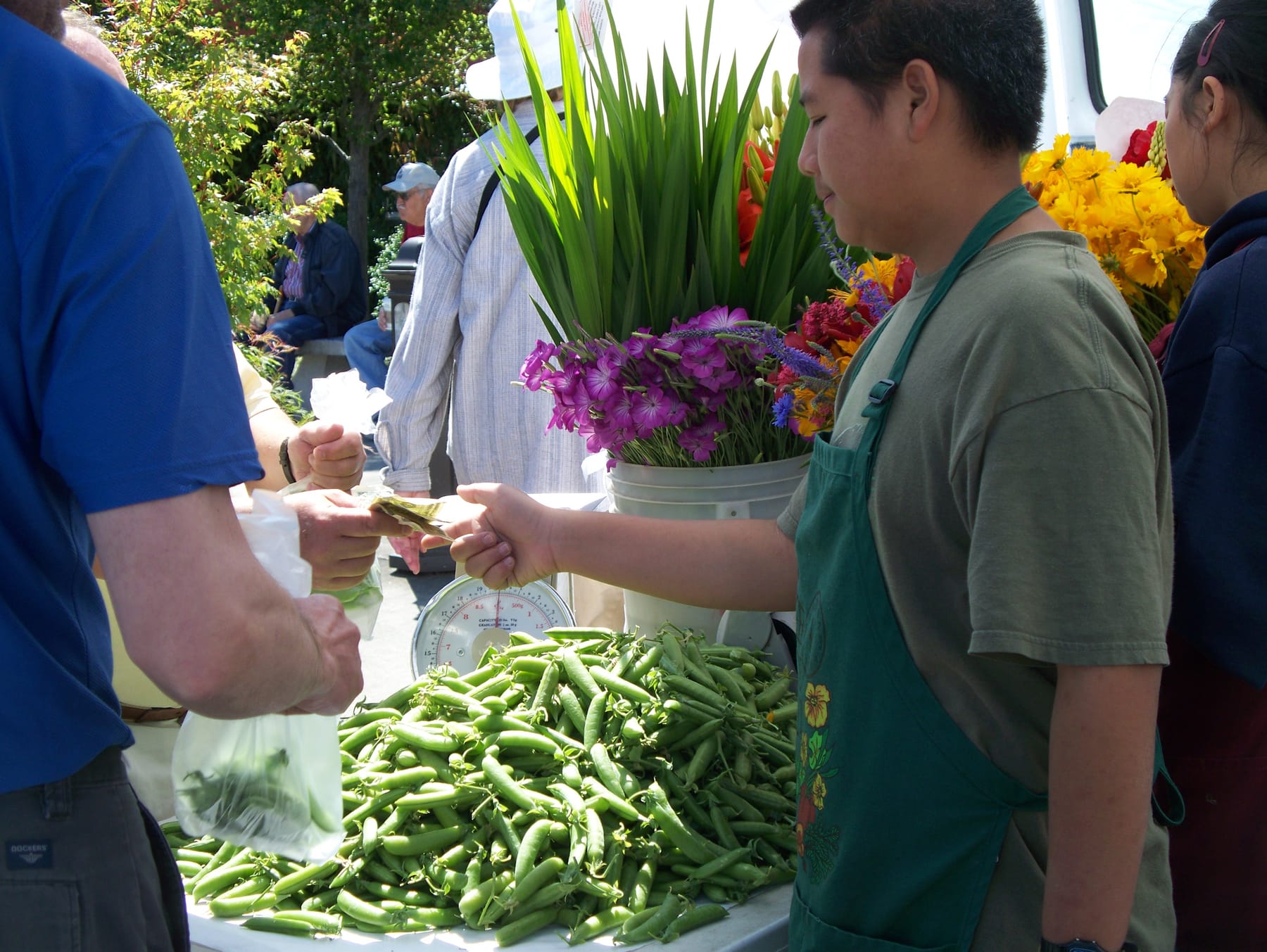
In this guide
Your first market is Saturday and the money question has more parts than it looks: the float in your apron, the card reader you have not bought, the customer who wants to Venmo you, the tax question nobody has answered, and the wooden token a shopper will hand you from the market's information tent. Here is how each works, what it cost when we checked on September 2, 2026, and what to set up before you load the truck.
Cash first: float, change, and where the money lives
Cash is the simplest sale at a market: no fee, no signal. It goes wrong in two ways, running out of change and losing track of what came in.
The float. The Maine Federation of Farmers' Markets describes a $100 starting wad: five tens, five fives, and twenty-five ones, folded with a rubber band around it. Penn State Extension's advice is blunter: make sure you have enough change for the cash box. How much depends on your prices. Whole-dollar prices need ones and fives and almost no coin; $4.50 and $7.75 need rolls of quarters and a slower line. Our pricing guide shows how to land on clean price points that still cover your costs.
Where the money lives. A locking cash box is the default, and the Maine Federation makes a fair case against it: a box sits apart from you, shows your cash to the whole line every time it opens, and is easy to lift the moment you step away. The alternative is money on your body, in a nail apron or a front pocket, with large bills moved to a locked bag in the vehicle as they accumulate. Either way, one person handles the money and knows where it is.
Counting. Count the float before you open, write it down, and count everything at close. The difference, less anything you bought from other vendors, is your cash sales. A tally sheet by denomination gives you a number to reconcile against your sales log and, later, your tax return. Our recordkeeping guide has a layout that works for both.
Counterfeits. The U.S. Currency Education Program tells cash handlers to take a quick glance at every note they receive and to rely on its security features rather than on how it looks at arm's length. Foreign writing, or the words "For Motion Picture Use Only" or "Replica," are signs it could be fake. Suspected counterfeits go to the nearest U.S. Secret Service field office. At a market, the practical version is to look at anything larger than a twenty before it goes in the apron.
Cards: what the reader costs and what each tap costs
Penn State Extension's Brian Moyer points out that many shoppers no longer carry cash, and those who do carry little, so taking electronic payment can meaningfully raise a day's sales. Most vendors land on one of three setups. A small Bluetooth reader paired to a phone takes chip and contactless cards and phone wallets. Tap to Pay on the phone itself needs no reader (Square's iPhone version requires an iPhone XS or newer on iOS 15.5 or later; Venmo offers it on iPhone and Android for business profiles), but it cannot help a customer whose card has to be inserted. A standalone terminal costs more and suits a stall doing volume.
Every major processor prices the same way: a percentage of the sale plus a fixed number of cents, deducted before the money reaches your bank. Here is what the official U.S. pricing pages showed on September 2, 2026. We are not ranking these; each has features (inventory, invoicing, loyalty) that may matter more to you than a tenth of a percent.
| Provider (entry plan) | In-person card rate | Manually keyed rate | Starter hardware |
|---|---|---|---|
| Square (Square Free) | 2.6% + 15¢ | 3.5% + 15¢ | Reader for contactless and chip, $59; Tap to Pay on iPhone at the same rate, no hardware |
| PayPal point of sale (Zettle) | 2.29% + 9¢ | 3.49% + 9¢ | First card reader $29, additional readers $79; Terminal $199 |
| SumUp (pay as you go) | 2.6% + 10¢ | 3.5% + 15¢ | Reader price not listed on the fee page |
None requires a monthly subscription for its entry plan (SumUp's page puts it as no monthly minimums and no hidden fees). All charge more for a card number typed by hand, so tap or dip and only key a card when the reader fails.
The fixed cents matter more than the percentage at a market. On a $6 loaf, Square's 2.6 percent plus 15 cents comes to about 31 cents, or 5.1 percent of the sale; on a $40 order it is $1.19, or 3 percent. Small tickets pay the highest effective rate, which is a reason to bundle (three for $10) and to build the fee into your prices. If a surcharge tempts you instead, check your state's rules and your processor's terms first.
Two practical notes. The reader needs your phone to have a data connection, so ask your processor what its app does when the signal drops; a rural market with one bar is where you will find out. And card processors send you and the IRS a Form 1099-K for your card volume no matter how small the total, so keep processor statements with your tax records.
Payment apps: convenient, but read the business terms
Venmo, Cash App, and Zelle are how many regulars would rather pay, and a QR code taped to the tent pole costs nothing. The catch is that each distinguishes personal use from selling, and taking sales on a personal account breaks the terms.
Venmo says it may not be used to receive business, commercial, or merchant transactions unless Venmo has authorized it. If a customer tags a payment to a personal profile as a purchase, Venmo takes a fee from the recipient (its example: a $100 payment arrives as $98) and does not return it if you refund. A business profile charges the seller 1.9 percent plus 10 cents per payment, or 2.29 percent plus 10 cents for Tap to Pay.
Cash App works the same way: a business account, with a 2.6 percent plus 15 cent fee on each payment received from a customer's Cash App and 3 percent on Tap to Pay.
Zelle lives inside your bank. You can use it for a business only if your bank or credit union offers Zelle on your business account type, and fees and limits are the bank's. Zelle offers no purchase protection and tells users not to pay people they do not know. For you that means no chargebacks, and also that a payment cannot be canceled once it reaches an enrolled account; confirm it on your screen, not just the customer's, before you hand over the bag.
On taxes: payment apps send a Form 1099-K when your gross payments through the platform exceed $20,000 and 200 transactions in a year, the pre-2021 threshold Congress restored in 2025. That is a reporting rule, not an income rule. Every sale is taxable income whether or not a form arrives.
Sales tax: the part that varies most
Sales tax is set by the state, and whether a market vendor collects it turns on two questions: does your state tax the thing you sell, and does it want a permit from you even if it does not? Three states show the range.
- Texas requires a sales tax permit to sell taxable items at a market, fair, or show, and you collect 6.25 percent state tax plus up to 2 percent local. But food products, including flour, sugar, bread, milk, eggs, fruits, and vegetables, are not taxable, while prepared food (heated by the seller, or sold with eating utensils) is.
- California treats anyone selling at a location for less than 90 days as a temporary seller and requires a free temporary seller's permit. If you sell only cold food, nothing hot or prepared, your sales are generally nontaxable and you do not need the permit.
- Idaho asks vendors at organized events, farmers markets included, to register through the event promoter for a temporary seller's permit good for 90 days; regular permit holders still register for the event.
So a produce grower and a hot-tamale vendor at the same Texas market are in different positions, and a cookie baker in California may owe nothing while the breakfast-burrito stand next door collects. Before your first market, call your state's revenue department with a list of what you sell, and ask your market manager what the market requires; some want a permit number on the application whether or not you owe tax. If you do collect, decide whether your posted price includes tax (ask whether your state allows it) and log taxed and untaxed sales separately from day one.
SNAP and EBT: two ways it reaches your table
SNAP benefits ride on an EBT card, and every EBT transaction needs the customer's PIN. USDA's Food and Nutrition Service explains that the consumer card readers sold for phones are not built to take PIN entry, so your Square or PayPal reader will not process SNAP. EBT needs its own path, and at a market there are two.
Path one: the market's scrip. A market can be authorized by FNS to accept SNAP on behalf of every vendor selling eligible food, including vendors who are not authorized themselves. The market runs a single EBT terminal at a central booth and sells its own currency, paper scrip or tokens in whole-dollar amounts such as $1, $5, or $10. The shopper swipes at the booth, walks the market with tokens, and you accept them like cash for SNAP-eligible foods. The market reimburses you on its own schedule, so ask how often and how.
The rules that come with the tokens are federal. SNAP scrip buys eligible food only; unused scrip must be refundable to the customer's EBT card; SNAP scrip must look different from any other token the market issues (a matching-dollar incentive, for instance); and the market must train every vendor on redemption and eligible foods. That training is not a formality: FNS warns that one vendor taking SNAP scrip for a non-eligible item can cost the market its FNS permit, which is why managers get strict about it. Our guide to SNAP, EBT, and Market Match covers the shopper's side and the incentive programs layered on top.
Path two: your own authorization. Direct-marketing farmers and farmers markets apply to FNS online. FNS is the only body that authorizes SNAP retailers, and there is no cost to apply. The application runs through a Login.gov account, takes as little as 15 minutes, and asks for the name, home address, and Social Security number of each owner plus sales data. You cannot take EBT until FNS issues your SNAP permit and FNS number.
Then you need equipment, and here farmers and markets get a break most retailers do not. FNS says eligible farmers markets and direct-marketing farmers may still qualify for free EBT equipment and services until further notice, through state equipment programs (29 states took FY2019 funding for SNAP-only devices, which cannot run credit or debit) and a mobile app provided free for one year through the National Association of Farmers Market Nutrition Programs. That app program is MarketLink, now run by the Farmers Food Assistance Bureau. As of our review it provides a free Bluetooth reader and a one-year TotilPay Go subscription with no per-transaction SNAP fees. The subscription extends free if you process $500 or more in SNAP during the grant year, while funding lasts or until September 30, 2028, whichever comes first; otherwise it costs $191.40 a year.
One honest caveat for cottage food sellers: the free-equipment programs are written for farmers and markets, and FNS tells applicants who are neither a retail food store nor a farmers market to call the SNAP Retailer Service Center (1-877-823-4369) rather than file online. A home baker selling bread, which SNAP can buy, will usually reach SNAP shoppers through the market's tokens rather than a permit of their own.
Before your first market
- Count and band a float that matches your price points, and put a tally sheet in the apron.
- Open a processor account a week early, charge the reader, and run one test sale on your own card.
- For app payments, set up a business profile, print the QR code, and post which apps you take.
- Call your state revenue department about permits and taxability for your products, and ask the market what it requires.
- Ask the market manager about its SNAP token program, take the training, and learn the redemption schedule.
- At close, reconcile: cash count minus float, plus the processor's total, plus app payments, plus tokens turned in. Write the four numbers down.
Do that once, and by the third market the money side will take less thought than the tent. The rest of first-season logistics, from applications to booth layout, is in our guide to becoming a farmers market vendor.
Sources and further reading
- 1.Handling your money at market · Maine Federation of Farmers' Markets · accessed Sep 2, 2026 · $100 starting float of five tens, five fives, and twenty-five ones; case against cash boxes; tally sheet by denomination
- 2.Do's and Don'ts for Selling at Farmers Markets · Penn State Extension · accessed Sep 2, 2026 · Brian F. Moyer, updated November 17, 2025; bring enough change; electronic payment can significantly increase daily sales
- 3.Cashier Toolkit · U.S. Currency Education Program · accessed Sep 2, 2026 · Take a quick glance at each note and rely on its security features; foreign writing, 'For Motion Picture Use Only,' or 'Replica' could mean a fake; report suspected counterfeits to the nearest Secret Service field office
- 4.Understanding Our Fees · Square · accessed Sep 2, 2026 · Square Free plan: 2.6% + 15¢ in person (tap, dip, swipe); 3.5% + 15¢ manually entered; no monthly subscription on Square Free
- 5.Tap to Pay on iPhone · Square · accessed Sep 2, 2026 · No reader needed; 2.6% + 15¢ per tap; requires iPhone XS or above running iOS 15.5 or later
- 6.Square Reader for contactless and chip · Square · accessed Sep 2, 2026 · $59; accepts chip cards, contactless cards, Apple Pay, and Google Pay
- 7.Point of Sale Pricing and Fees · PayPal · accessed Sep 2, 2026 · Card-present 2.29% + $0.09; manual entry 3.49% + $0.09; first Card Reader $29, additional $79; Terminal $199; no monthly or setup fees
- 8.Low-Cost Credit Card Processing for Small Business · SumUp · accessed Sep 2, 2026 · In-person 2.6% + 10¢; online and manual entry 3.5% + 15¢; no monthly minimums on the pay-as-you-go plan
- 9.Business Profile Transaction Fees · Venmo · accessed Sep 2, 2026 · Seller fee 1.9% + $0.10; Tap to Pay on iPhone or Android 2.29% + $0.10; deducted automatically from the payment
- 10.Buying and Selling on Venmo FAQ · Venmo · accessed Sep 2, 2026 · Venmo may not be used to receive business, commercial, or merchant transactions unless authorized; purchase-tagged $100 payment arrives as $98
- 11.Selling with Personal Profiles · Venmo · accessed Sep 2, 2026 · Fee on purchase-tagged payments is not returned on refund; frequent sellers directed to business profiles
- 12.Cash App for Business Fees · Cash App · accessed Sep 2, 2026 · 2.6% + $0.15 on each payment received from a customer's Cash App to a Cash App Business account; 3% for Tap to Pay
- 13.I'm a Small Business Using Zelle · Zelle · accessed Sep 2, 2026 · Business use requires a bank or credit union that offers Zelle for the business account type; fees and limits set by the financial institution; payments to enrolled recipients cannot be canceled
- 14.I'm unsure about using Zelle to pay someone I don't know. What should I do? · Zelle · accessed Sep 2, 2026 · Zelle does not offer purchase protection; recommends against paying people you do not know
- 15.Understanding your Form 1099-K · Internal Revenue Service · accessed Sep 2, 2026 · Page reviewed June 28, 2026. Payment app threshold: more than $20,000 and more than 200 transactions; payment card processors issue a 1099-K regardless of amount
- 16.IRS issues FAQs on Form 1099-K threshold under the One, Big, Beautiful Bill; dollar limit reverts to $20,000 (IR-2025-107) · Internal Revenue Service · accessed Sep 2, 2026 · October 23, 2025; 2025 law retroactively reinstated the pre-2021 threshold
- 17.Fairs, Festivals, Markets and Shows (Publication 96-211) · Texas Comptroller of Public Accounts · accessed Sep 2, 2026 · Permit required to sell taxable items at events; 6.25 percent state tax plus up to 2 percent local
- 18.Grocery and Convenience Stores (Publication 96-280) · Texas Comptroller of Public Accounts · accessed Sep 2, 2026 · Food products (flour, sugar, bread, milk, eggs, fruits, vegetables) not taxable; prepared food, including items heated by the seller or sold with eating utensils, is taxable
- 19.Temporary Sellers · California Department of Tax and Fee Administration · accessed Sep 2, 2026 · Selling at a location for less than 90 days makes you a temporary seller; the temporary seller's permit is free; sellers of only cold food (not hot prepared) are generally nontaxable and need no permit
- 20.Farmers markets, events sellers reminded to collect and pay sales tax · Idaho State Tax Commission · accessed Sep 2, 2026 · March 24, 2023; register with the event promoter for a temporary seller's permit valid 90 days; regular permit holders still register for the event
- 21.SNAP Farmer/Producer · USDA Food and Nutrition Service · accessed Sep 2, 2026 · Page updated May 29, 2026. Direct marketing farmers and farmers markets apply online; all authorized retailers must use EBT equipment
- 22.How Do I Apply to Accept SNAP Benefits? · USDA Food and Nutrition Service · accessed Sep 2, 2026 · Updated May 5, 2026. No cost to apply; FNS is the only authorizer; Login.gov; as little as 15 minutes; owner names, addresses, SSNs, and sales data; eligible farmers markets and direct-marketing farmers may qualify for free EBT equipment until further notice; non-stores call 1-877-823-4369
- 23.Scrip System (Paper Scrip, Token, or Receipts) · USDA Food and Nutrition Service · accessed Sep 2, 2026 · Updated October 25, 2024. Market may accept SNAP for all vendors selling eligible food; whole-dollar scrip; unused scrip refundable to the EBT card; SNAP scrip must differ from other scrip and resist counterfeiting; vendors must be trained; a vendor violation can cost the market its permit
- 24.SNAP EBT Equipment Resources · USDA Food and Nutrition Service · accessed Sep 2, 2026 · Page updated February 5, 2026. State equipment programs (29 states funded in FY2019, SNAP-only devices); NAFMNP mobile app free for one year
- 25.Smartphones and Tablets · USDA Food and Nutrition Service · accessed Sep 2, 2026 · Page updated June 18, 2024. Consumer credit and debit readers on phones are typically not designed to accept PIN entry; a PIN is a basic component of every EBT transaction
- 26.SNAP Equipment Grant · MarketLink (Farmers Food Assistance Bureau) · accessed Sep 2, 2026 · Free Bluetooth reader and one-year TotilPay Go subscription, no SNAP transaction fees; free extension if $500+ in SNAP is processed in the grant year, while funding lasts or until September 30, 2028; otherwise $191.40 per year; program of the Farmers Food Assistance Bureau, USDA-funded
- 27.What Can SNAP Buy? · USDA Food and Nutrition Service · accessed Sep 2, 2026 · Page updated June 4, 2025. Eligible foods include breads and cereals, fruits and vegetables, dairy, and meat
Weekly newsletter
Market Dispatch
One email a week with the newest guide, what's in season, and a few things worth knowing before market day.
Email subscriptions are not open yet. Read every new story through our free RSS feed.
Follow Market Dispatch via RSS →Keep reading
How to Become a Farmers Market Vendor: The Complete First-Season Guide
How markets are organized and why it changes what they ask of you, how to read a rulebook before you apply, what fees, insurance, and sales tax involve, what to bring, how the first morning runs, and how to judge the numbers after a month.
· 14 min read
How to Price Baked Goods and Homemade Foods (With a Worked Example)
Home bakers routinely leave their own labor and the market fee out of the price. This is the cost-based method extension economists teach, worked through on a hypothetical batch of cookies so you can see every number move.
· 12 min read
How to Find the Right Farmers Market for What You Sell
The USDA directory alone lists more than 7,000 farmers markets. Here is where to look, what a listing cannot tell you, and how two visits as a shopper and one conversation with the manager reveal whether a market actually needs what you make.
· 8 min read
Wind, Rain, and Heat: Weather Preparation for Market Vendors
A pop-up canopy is a sail with a price tag. What markets require for weights and how to attach them, when to drop the tent, how to keep product dry and cold food cold, and how you hear when a market calls it off.
· 8 min read