
BusinessGuide
How to Price Baked Goods and Homemade Foods (With a Worked Example)
Home bakers routinely leave their own labor and the market fee out of the price. This is the cost-based method extension economists teach, worked through on a hypothetical batch of cookies so you can see every number move.
 United Farmers Market Editorial Team
In this guide
- Why home bakers underprice
- Step 1: Cost every ingredient per batch, then per unit
- Step 2: Add packaging and the label
- Step 3: Pay yourself a real hourly rate
- Step 4: Spread overhead across what you actually sell
- Step 5: Add the margin and set the price
- Markup and margin are not the same number
- Step 6: Check the price against the market
- Caps, sales tax, and self-employment tax change the math
- How to raise prices without losing regulars
- What to do this week
A lot of pricing at a market table starts the same way. You look at what the bakery downtown charges, shave a dollar off because you bake at home, and hope the math works out. It usually doesn't. The bakery's price was built on the bakery's costs, and yours include things it never thinks about: a stall fee spread across a few dozen bags of cookies, a 7 a.m. drive with a folding table in the back seat, a card reader taking its cut of every sale.
This guide walks through the cost-based method extension services teach food entrepreneurs, then applies it to a hypothetical batch of chocolate chip cookies so you can watch every number move. The prices, hours, and fees are invented on purpose; swap in your own receipts and the method holds.
Why home bakers underprice
Underpricing rarely comes from bad arithmetic. It comes from leaving things out. The costs a home baker sees are the ones with a receipt: butter, chocolate, bags, labels. The ones without a receipt get skipped: the evening spent baking, the six hours behind the table, the miles on the car, the tent that will need replacing in two seasons.
Grocery anchoring makes it worse: a supermarket cookie is made at a scale you will never match, and measuring your product against it guarantees a losing number.
Guilt is the third culprit. Sellers feel awkward charging a neighbor real money for something they enjoy making, so they price as if their time were free. The University of Maine's pricing bulletin for small businesses states the consequence plainly: prices set too low do not generate enough gross income to cover expenses. A table that loses money every Saturday is a hobby, and it ends the first season the enthusiasm does.
A fourth reason applies only to cottage food. Many states cap what a home producer can gross in a year; Texas raised its threshold for cottage food production operations to $150,000 in 2025. A cap limits revenue, not profit. Every underpriced sale spends room under the cap and brings back less for it.
Step 1: Cost every ingredient per batch, then per unit
Start with one recipe you sell regularly and cost a single batch. For each ingredient, turn the purchase price into a price per unit of weight, then multiply by the amount the recipe uses. A 5-pound bag of flour at $3.00 is $0.60 a pound; a recipe that uses 1.25 pounds costs $0.75 in flour.
Weigh, don't scoop. Cups vary with how you fill them; grams don't. Weigh everything once while you cost the recipe and you get numbers you can trust.
The table costs a hypothetical batch of 48 chocolate chip cookies, packed six to a bag, at invented prices. Your flour will not cost what this flour costs. That is the point of doing it yourself.
| Ingredient | Amount in batch | Purchase price (hypothetical) | Cost in batch |
|---|---|---|---|
| Butter | 1 lb | $4.50 per lb | $4.50 |
| Sugar, white and brown | 1.5 lb | $1.00 per lb | $1.50 |
| All-purpose flour | 1.25 lb | $3.00 per 5-lb bag | $0.75 |
| Eggs | 2 | $3.60 per dozen | $0.60 |
| Chocolate chips | 24 oz | $4.00 per 12-oz bag | $8.00 |
| Vanilla extract | 2 tsp | $12.00 per 4-oz bottle | $1.00 |
| Baking soda and salt | small amounts | pennies | $0.10 |
| Batch total | 48 cookies | $16.45 |
That works out to about 34 cents a cookie, or $2.06 per bag of six. Notice where the money is: chocolate is nearly half the batch cost. If you ever need to trim ingredient cost, that is the line to look at, and it is also the line customers taste first. Pricing and product choice are one decision, which is why our guide to choosing a cottage food product line keeps returning to cost per unit.
Update the sheet whenever a staple's price moves, and count the small things: parchment, the flour on the counter, the tray that gets eaten by the family.
Step 2: Add packaging and the label
Every unit needs a container and, under most state cottage food laws, a label. Cost them the same way: the price of the pack divided by the count. In the example, a kraft window bag runs $0.20, a printed label $0.15, and a closure sticker $0.05, for $0.40 a bag or $3.20 a batch. Bought by the case those numbers fall; bought at the craft store the Friday before market, they double. The packaging guide covers materials and where the money goes.
Step 3: Pay yourself a real hourly rate
This is the step home bakers skip most often, and it decides whether the business survives.
Time the whole job, not just the mixing: a share of the shopping trip, measuring, mixing, scooping, four sheet pans through a home oven, cooling, bagging, labeling, cleanup. Call it 90 minutes for one batch. Then pick an hourly rate. The right number is roughly what a bakery would pay someone with your skills, not the legal minimum. The example uses $20 an hour, which puts labor at $30 a batch, or $3.75 a bag.
Two things about that wage. It is not take-home pay: once net earnings from self-employment reach $400 in a year, the IRS applies a 15.3 percent self-employment tax on top of income tax. And it belongs in the cost line, not the margin. Margin is what the business earns after everyone, including you, has been paid. Treat your wage as the profit and you have no profit.
Step 4: Spread overhead across what you actually sell
Overhead is everything that does not attach to one bag of cookies but has to be paid anyway. Extension economists split costs into variable (they rise and fall with how much you make: ingredients, packaging, direct labor) and fixed (they arrive whether you bake or not: insurance, equipment, permits). Both kinds come out of the price.
For a market seller the usual lines are:
- Market fees. Structures vary. Salt Lake City's Downtown Farmers Market, to take one published 2026 schedule, charges its farm vendors a $50 application fee, $780 for a full-season 10-by-10 booth, $40 for a day stall, and 10 percent of daily sales for value-added products. Look up the schedule for your own vendor category rather than the farm one. A percentage-of-sales fee is a cost per unit and should be treated as one.
- Mileage. The IRS business standard mileage rate is 76 cents a mile for miles driven July 1 through December 31, 2026 (72.5 cents for the first half of the year). A 20-mile round trip is $15.20.
- Insurance, permits, registration. Annual costs, divided by the markets you plan to work.
- Equipment. Tent, tables, scale, sheet pans: purchase price divided by the years it will last, then by markets per year.
- Kitchen share. A modest allowance for the utilities production uses.
- Selling labor. Loading, driving, setting up, selling, and tearing down are labor too. They sit in overhead because they do not change with how many bags you bake.
The example week, at hypothetical figures:
| Weekly overhead line | Amount |
|---|---|
| Day stall fee | $40.00 |
| Mileage, 20 miles at 76 cents | $15.20 |
| Insurance, $300 a year over 25 markets | $12.00 |
| Equipment, $500 over two seasons of 25 markets | $10.00 |
| Kitchen utilities share | $5.00 |
| Selling labor, 7 hours at $20 | $140.00 |
| Total | $222.20 |
The baker makes eight batches for Saturday, 64 bags, and from experience expects to sell 56; the rest are discounted at closing or given away. Divide overhead by the 56 bags you expect to sell, not the 64 you made. Unsold product is a cost the sold product carries. With several products, the University of Florida's costing primer for food entrepreneurs recommends splitting shared overhead by a sensible driver, most often the production time each product takes.
Overhead per bag sold: $222.20 divided by 56, or $3.97.
Step 5: Add the margin and set the price
Pull the pieces together per bag sold. Ingredients and packaging were costed per bag made; multiply by 64 and divide by 56 to put them on the same footing.
| Cost per bag sold | Amount |
|---|---|
| Ingredients ($16.45 × 8 batches ÷ 56) | $2.35 |
| Packaging ($0.40 × 64 ÷ 56) | $0.46 |
| Baking labor ($30 × 8 ÷ 56) | $4.29 |
| Overhead (from Step 4) | $3.97 |
| Card processing, rough average | $0.35 |
| Full cost | $11.42 |
The card line uses Square's published in-person rate on its free plan, 2.6 percent plus 15 cents: 54 cents on a $15 sale, or about 32 cents averaged across every bag if six shoppers in ten pay by card, rounded up a little for small tickets. Use your own processor's rate; our guide to accepting payments at farmers markets covers the options.
Now the margin. The formula extension bulletins use is:
Price = full cost ÷ (1 − target margin)
Mississippi State's pricing and breakeven bulletin presents it in that form and notes that a 40 percent gross margin is common in food wholesale pricing. A direct seller who has already loaded selling costs into overhead can reasonably target less, because the margin now only has to fund profit and the bad weeks. At 25 percent, the example price is $11.42 ÷ 0.75, or $15.23. Round to $15 for a bag of six, which is $2.50 a cookie, and sell singles at $3 so the bag is the obvious deal.
If that looks high, run the version many home bakers actually run. Skip both labor lines and the cost rests on ingredients, packaging, fees, mileage, and equipment: about $4.63 a bag. Price at $6, sell 56 bags, and the $1.38 left on each one adds up to $77. Divide that by the 19 hours of baking and selling behind it and you paid yourself $4.05 an hour. That is the arithmetic of underpricing, and it stays invisible until you do it.
Markup and margin are not the same number
Markup is measured against cost. Margin is measured against selling price. The Maine bulletin gives both formulas:
- Markup on cost = (selling price − cost) ÷ cost
- Margin on selling price = (selling price − cost) ÷ selling price
Because the selling price is always the larger number, the margin percentage is always the smaller one. A 50 percent markup is a 33.3 percent margin. On the example cookies:
| Target | Price on an $11.42 cost | Kept per bag |
|---|---|---|
| 30 percent markup | $14.85 | $3.43 (23 percent of price) |
| 30 percent margin | $16.31 | $4.89 (30 percent of price) |
| 50 percent markup | $17.13 | $5.71 (33 percent of price) |
When someone tells you to "add 30 percent," ask which they mean, and write your own target down as a margin.
Step 6: Check the price against the market
Cost sets the floor; the market tells you what shoppers here, this morning, will pay. You need both. Penn State's Food for Profit series makes the same point from the other side: a price built only on costs, especially with start-up costs folded in, may not compete with established brands, and most food entrepreneurs end up combining cost-based and competition-based pricing.
So walk the market before you set up. Write down what comparable items sell for, per unit and per ounce, and note who sells out by 11 a.m. and who packs up full boxes at closing. Compare the product, not just the price: a $15 bag of six large butter cookies with a clean label is a different thing from a $6 bag of small ones, and shoppers know it.
If your cost-based price lands well above the market, you have a few honest choices: cut costs where the customer will not notice (buy by the case, bake fewer so fewer go unsold), change the format so the number reads differently (three for $8), find a market whose shoppers match the product, or sell something else. What does not work is quietly setting labor back to zero.
If your number lands below the market, raise it. You are leaving money on the table and undercutting the vendor next to you who did the math.
Caps, sales tax, and self-employment tax change the math
Three rules from outside the kitchen affect what a price is worth to you, and all three vary by state.
Sales caps. Where a state caps annual cottage food revenue, as Texas does at $150,000, sales are limited but profit is not, so margin per dollar of revenue is the number that matters most. Our state cottage food guides list current caps, and Cottage Food Sales Limits Explained covers how they are counted.
Sales tax. Washington's Department of Revenue, for example, treats bakery items as exempt from retail sales tax unless sold with eating utensils the seller provides. Other states draw the line elsewhere. Ask your state revenue department whether you need a sales tax permit, and decide before opening day whether sign prices include tax.
Self-employment tax. Once net earnings hit $400 for the year, the 15.3 percent self-employment tax applies. Build it into the wage in Step 3 rather than discovering it in April.
How to raise prices without losing regulars
Sooner or later the cost sheet will tell you to raise prices, and the fear of losing the Saturday faces you know by name will tell you not to.
Raise on a schedule. Once a year, at the start of the season, is easier to explain than a mid-summer surprise. Put the date on your calendar now.
Give two weeks' notice. A small sign at the table and a line in your email or social posts. Regulars would rather hear it from you than notice it at the register.
Give one reason, no apology. "Butter and chocolate are up; the new price keeps the recipe the same." Then stop talking. Over-explaining invites negotiation.
Do not shrink the product instead. Regulars notice a lighter bag, and it reads as sneaky in a way a posted price increase does not.
Keep one easy entry item. A single cookie or a half loaf, so nobody who loved your table gets priced off it.
Honor commitments. Pre-orders taken at the old price get the old price.
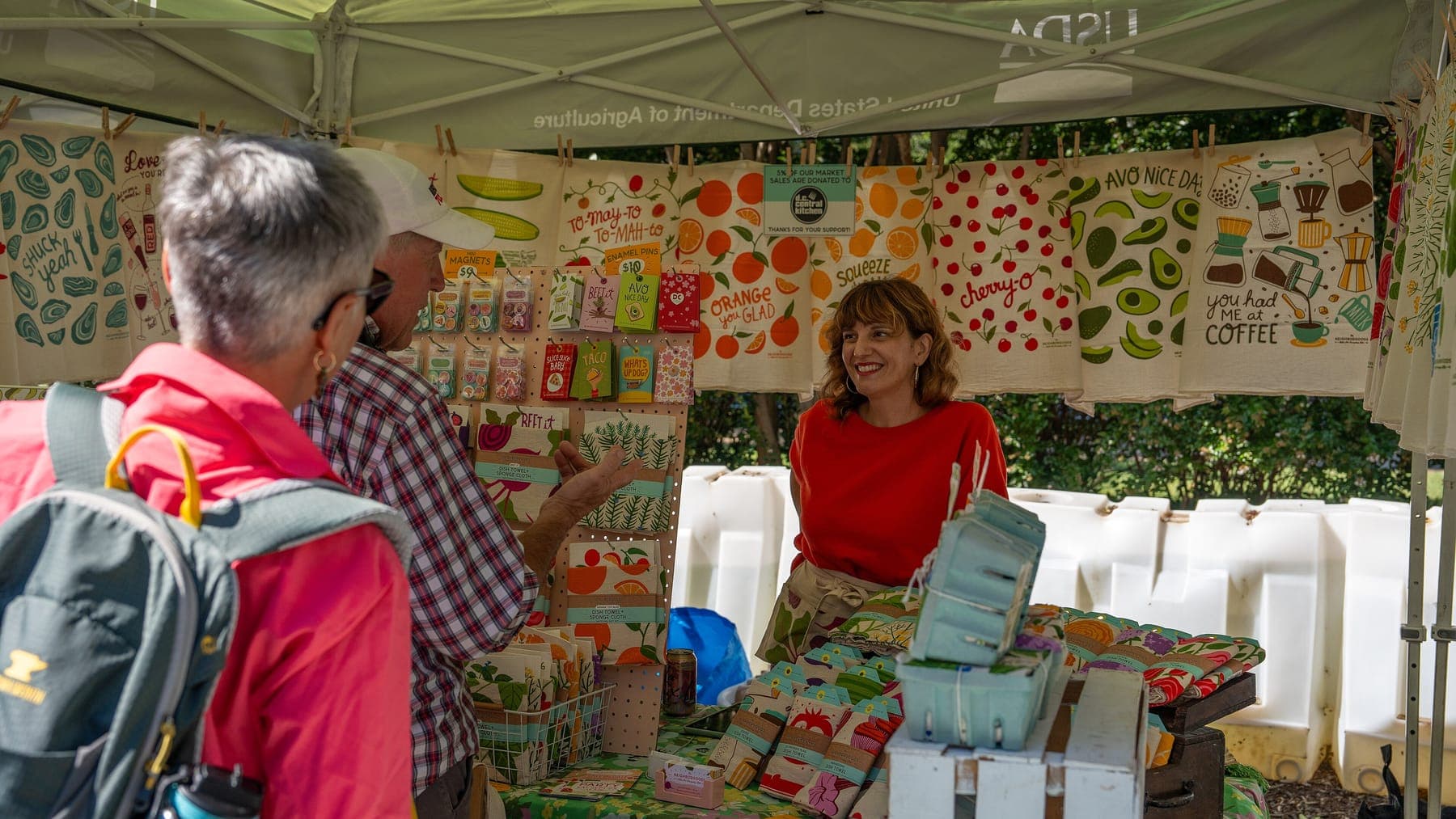
The people who come back every week are buying the product and the person behind it. Our guide to turning market customers into regulars covers the habits that make that true; a price change handled well is one of them.
What to do this week
- Cost one recipe by weight, using the ingredient table as a template.
- Time one full batch, shopping and cleanup included, and pick your hourly rate.
- List overhead for a typical market week, market-day hours included, and divide by the units you honestly expect to sell.
- Add margin with the Step 5 formula.
- Walk the market with a notebook before your next setup and compare.
- Set a date about three months out to run the numbers again.
If you are still deciding whether to sell at all, start with how to start a cottage food business and how to become a farmers market vendor, then come back with real numbers. The method does not change. Only the receipts do.
Sources and further reading
- 1.Bulletin #3000, Basic Pricing Strategies for Small Businesses · University of Maine Cooperative Extension · accessed Sep 2, 2026 · Cost-plus formula, markup on cost versus margin on selling price, consequences of pricing too low
- 2.Product Pricing and Breakeven Concept (P3671) · Mississippi State University Extension Service · accessed Sep 2, 2026 · Selling price = cost of goods sold ÷ (100% − desired gross margin); fixed and variable cost definitions; 40 percent gross margin in food wholesale
- 3.Food for Profit: Price and Pricing · Penn State Extension · accessed Sep 2, 2026 · Cost-based versus competition-based pricing; contribution margin and break-even; start-up costs loaded into price may not compete with established brands; most entrepreneurs combine both methods
- 4.Knowing Your Product Costs: A Primer for Farmers and Food Entrepreneurs (FE1103) · University of Florida IFAS Extension · accessed Sep 2, 2026 · Allocating shared overhead to products by a cost driver such as production time
- 5.Standard mileage rates · Internal Revenue Service · accessed Sep 2, 2026 · Business rate 72.5 cents per mile Jan 1 to Jun 30, 2026; 76 cents per mile Jul 1 to Dec 31, 2026
- 6.Self-employment tax (Social Security and Medicare taxes) · Internal Revenue Service · accessed Sep 2, 2026 · 15.3 percent rate; applies when net earnings from self-employment reach $400
- 7.Farmers & Growers: vendor fees, Downtown Farmers Market · Downtown Alliance, Salt Lake City · accessed Sep 2, 2026 · 2026 Farmers & Growers fee schedule: $50 application, $780 full season 10-by-10 booth, $40 day stall, 10 percent of daily sales for value-added products
- 8.Texas Cottage Food Production · Texas Department of State Health Services · accessed Sep 2, 2026 · SB 541 (implementation by September 1, 2025) raised the annual gross income threshold for cottage food production operations to $150,000
- 9.Bakeries (industry guide) · Washington State Department of Revenue · accessed Sep 2, 2026 · Bakery items exempt from retail sales tax unless sold with eating utensils provided by the seller
- 10.What are Square's fees? · Square · accessed Sep 2, 2026 · U.S. in-person tap, dip, or swipe: 2.6% + 15¢ on Square Free (2.5% + 15¢ on Plus, 2.4% + 15¢ on Premium)
Weekly newsletter
Market Dispatch
One email a week with the newest guide, what's in season, and a few things worth knowing before market day.
Email subscriptions are not open yet. Read every new story through our free RSS feed.
Follow Market Dispatch via RSS →Keep reading
How to Start a Cottage Food Business: A Step-by-Step Guide
From the first read of your state's rules to your first market Saturday, in eight steps: choosing products that qualify, registration and training, labels, pricing, sales channels, bookkeeping, and a realistic plan for the first 90 days.
· 13 min read
What to Sell: Choosing a Cottage Food Product Line That Works at the Market
You can probably make twenty things well. A market needs three or four you can make every week, that hold up on a folding table, that your state allows, and that nobody else in the tent row is already selling. Here is a set of filters for getting from twenty to four.
· 11 min read
Packaging for Cottage Food: Materials, Costs, and Presentation That Protects the Product
A bag or box has three jobs: keep the product safe and fresh, carry the label your state requires, and sell it from three feet away. Here is how to choose packaging by product type, what a unit really costs, and which states require sealed, labeled packages before you can sell.
· 12 min read
Turning First-Time Buyers Into Regulars: Retention for Very Small Food Businesses
A stranger buys once because of a sign and a sample. A regular buys twenty times a season because of you. Here is why the second kind of customer carries a one-person food business, and the plain habits that make more of them.
· 8 min read