
Cottage FoodGuide
The Holiday Cookie Box: Pricing, Packaging, and Production Planning
A cookie box is a manufactured product with six recipes inside it, one label on the outside, and a delivery date you cannot move. Here is how to design the assortment, schedule the freezer work, cost a box honestly, and cap pre-orders before you take one too many.
 United Farmers Market Editorial Team
In this guide
A holiday cookie box is not a bake sale in a nicer container. It is a manufactured product: six recipes inside, one label outside, and a handoff date you cannot move. The assortment wants deciding in September, and the dough wants freezing by Halloween. Start on December 12 instead and you bake until 2 a.m. and hand over a box that cost you more than you charged for it. The dollar figures in the costing section are illustrative, built to show the method. Your ingredient costs will not match them.
Design the box before you touch a mixing bowl
Start with the count, because the count decides everything downstream. A box of 24 divides evenly into six varieties of four; a box of 12 is four varieties of three; a box of 36 is six of six and heavier than people expect. Pick a number that divides cleanly and you never end up at midnight holding an odd cookie.
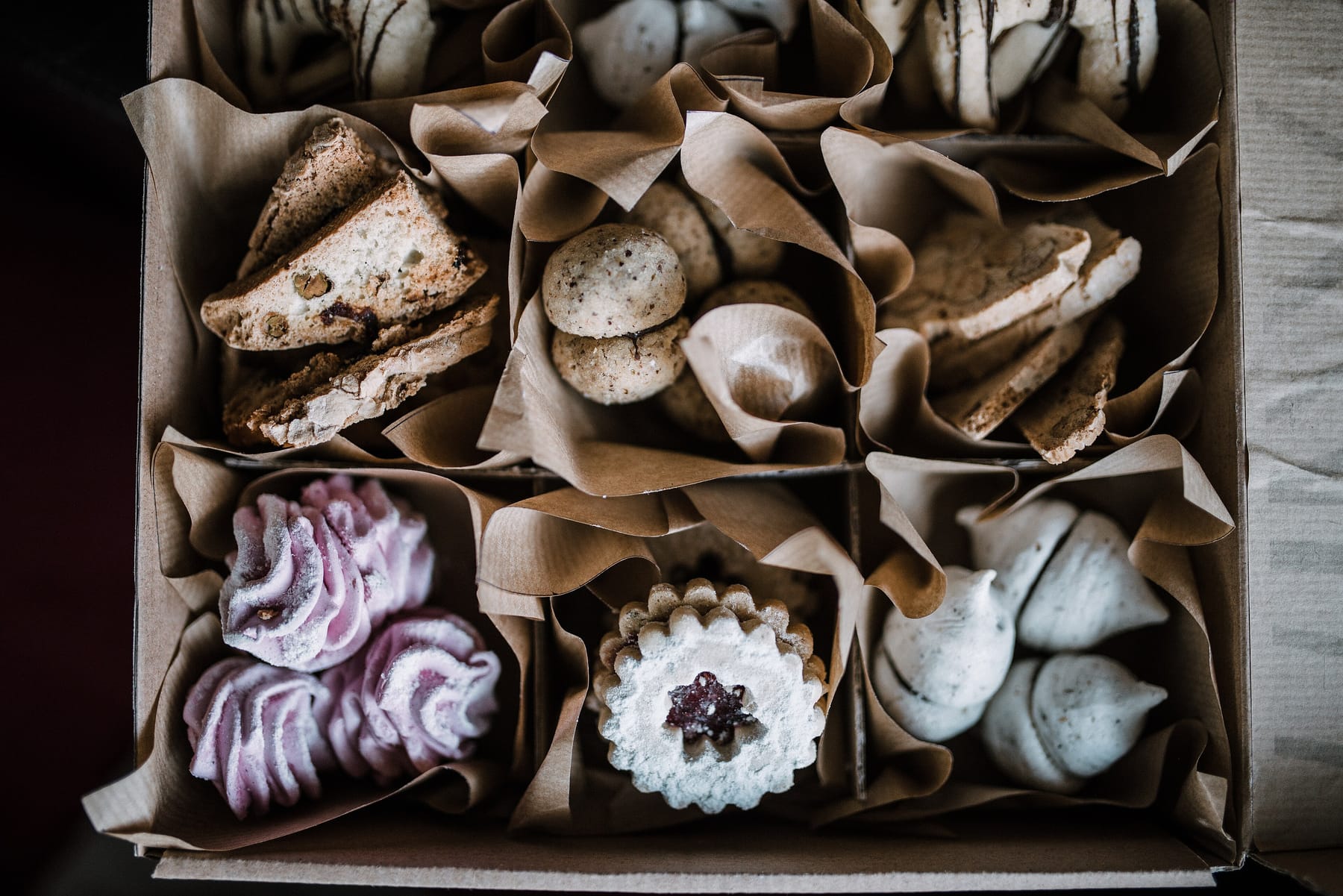
Then cast the varieties by role, not by favorite. A box reads well with one chocolate, one spice, one bright or fruit-forward cookie, one nut cookie, one decorated cookie, and one plain butter cookie that gives the eye a rest. Five is a legitimate box. Seven strains a home oven and a single label. Our guide to choosing a cottage food product line applies the same logic across a year.
Texture is where boxes fail. University of Minnesota Extension's water activity guidance explains that water in a baked good distributes fully and evenly through the product when it sits in a closed container for several days. A gift box is a closed container. Seal a crisp shortbread next to a soft molasses cookie, leave it a week under a tree, and both end up somewhere in the middle. Keep soft varieties to two at most and separate them with paper. That same page notes Minnesota's 0.85 water activity cap, so the moistest thing in your box may not qualify there at all.
| Variety | What it does for the box | Watch for |
|---|---|---|
| Shortbread or slice-and-bake icebox | Freezes as a log, bakes fast, holds a sharp edge | Picks up moisture from soft neighbors |
| Biscotti | Dry by design, the best traveler in the box | Reads plain if nothing else is decorated |
| Chocolate crinkle | Dark color against pale cookies | Powdered sugar rubs off in transit |
| Jam thumbprint | Color from the fruit, no icing labor | Tacky surface needs its own liner |
| Gingerbread or molasses | Carries the smell people expect | Soft versions raise moisture in a sealed box |
| Nut snowball | Rich and dense, travels well | The allergen that reshapes your whole label |
Last filter: fragility. Cookies that survive a car trunk are thick and dense with no thin protruding edges. Royal icing spires look wonderful on a tray and arrive in pieces.
Work backward from pickup day
The freezer is what makes this product possible in a home kitchen, and the storage windows are not folklore. K-State Research and Extension's freezing guidance sets the freezer at 0°F or lower, says to cool baked goods completely before packaging so condensation does not make them soggy, and calls for moisture-proof, vapor-proof wraps or rigid containers with tight lids. NDSU Extension's Food Storage Guide adds the number that shapes the schedule: baked cookies keep two to three weeks in an airtight container in the cupboard and do not need refrigeration.
The two charts disagree on dough, and the honest answer is to plan to the shorter one.
| What you freeze | Extension window at 0°F | How it goes in |
|---|---|---|
| Unbaked drop dough | 2 months (NDSU) to 6 months (K-State) | Scooped into mounds, frozen firm on a sheet, then bagged |
| Slice-and-bake logs | Same window | Shaped into a roll and wrapped; thaw in the fridge until sliceable |
| Baked, unfrosted cookies | Up to 12 months (K-State) | Fully cooled, rigid container, moisture- and vapor-proof wrap |
| Baked, frosted cookies | Up to 2 months (K-State) | Frozen on a sheet first, then layered with waxed paper |
K-State also notes that frozen dough mounds bake without thawing at 400°F in about 10 minutes, which is what makes the schedule work: the freezer holds inventory in its most flexible form. Doughs go in through October and November, baking happens the week of pickup, and icing and assembly come last, ideally inside the two days before handoff.
One safety rule belongs in the schedule, not a footnote. The FDA's guidance on handling flour safely is blunt: never eat or taste raw flour, dough, or batter, because milling grain into flour does not kill bacteria such as Salmonella and pathogenic E. coli. Outbreaks tied to raw flour since 2009 have caused 168 known illnesses and 20 hospitalizations, and the FDA says not to heat treat flour at home. No dough tastings at the table, and no edible cookie dough unless the flour came already treated for it. K-State's holiday freezing tips, from Rapid Response Center coordinator Karen Blakeslee, add the companion habit: wash your hands after handling dough.
What a box actually costs
Use the same method as any other product: ingredients, packaging, labor at a real hourly rate, a share of overhead, then margin. Our pricing guide works through each line and the markup-versus-margin trap. The illustrative figures below assume a run of 40 boxes of 24 cookies.
| Line item (40-box run) | Per box |
|---|---|
| Ingredients, 24 cookies at 25 cents | $6.00 |
| Box, divider, glassine, labels, seal | $2.90 |
| Labor: 21 hours mixing and baking, 4.7 hours assembly, at $20 | $12.85 |
| Overhead share (utilities, insurance, platform fee, mileage) | $1.25 |
| Full cost | $23.00 |
Apply the pricing guide's formula, price equals full cost divided by one minus your target margin, and a 25 percent margin puts the box at $30.67, a 35 percent margin at $35.38. Round to $31 or $35 and you have a defensible number.
Two sanity checks. At the pricing guide's example rate of $2.50 a cookie, 24 cookies sold loose would be $60 of retail, so a $35 box is visibly a volume price, not a premium one. And look hard at the labor line: nearly 26 hours across a 40-box run is not pessimistic for one home oven, and deleting it is how a season turns into unpaid work. Where a state caps cottage food revenue, a strong December moves you toward the ceiling. Texas sets its annual gross income threshold at $150,000.
Boxes, inserts, and the order you place in October
A finished box is five or six purchased components: the outer box, a divider or cavity insert, glassine sheets, the label, a seal or ribbon, and often a gift note card. K-State's rigid-container advice is packaging advice as much as freezer advice, and the insert earns its cost twice: it keeps varieties apart and makes a home-baked assortment look like a product.
Order early, and order samples first. Custom printing carries a minimum order quantity and holiday lead times stretch, so the safer route is a stock box with your own printed label. Our packaging guide has the cost-per-unit math. Buy one of every component, pack a real box, close it, and leave it on the counter for three days before you commit to a case.
If you are hoping to mail boxes, check your state before your carrier. Shipping rules vary widely, and Texas permits online sales only when the operator, an employee, or a household member personally delivers the food.
Labeling an assortment
The box is the package, so the box carries the label. Treat the assortment as one product, named something like "holiday cookie assortment," with one label on it, and make sure every variety's ingredients still reach the customer.
The core elements hold across states even when the wording does not. Illinois Extension's summary lists the business name, the common or usual product name, all ingredients in descending order by predominance of weight, net weight excluding packaging, the state's home-kitchen statement, the date the product was processed, and allergen labeling per federal requirements. The Georgia Department of Agriculture requires net weight or volume and sets typography rules for its disclosure: capital letters, Times New Roman or Arial, at least 10-point type, in a contrasting color. Texas now lets cottage food operations sell foods that need time and temperature control for safety, but the operation has to register with the state health department, and the label has to carry the date the food was made plus a safe handling statement in at least 12-point type. If a cream-cheese-frosted cookie is in the lineup, that is the paragraph to read twice.
An assortment concentrates allergens. The FDA recognizes nine major food allergens, with sesame required on labels as of January 1, 2023, and each may be declared by its common name in the ingredient list, in parentheses after an ingredient, or in a "Contains" statement. Six varieties commonly put wheat, milk, eggs, soy, and tree nuts on one line.
One layout covers both jobs: a printed insert card naming each variety with its own ingredient list, tucked under the lid, plus a single "Contains" statement on the outer label for the whole box. Agency pages generally do not address gift boxes directly, so confirm that layout with your own agency before printing 200 cards. Our labeling guide has the element-by-element breakdown.
A "may contain tree nuts" line, meanwhile, is not required by law. The FDA describes such advisory statements as a way to address unavoidable cross-contact, says they must be truthful and not misleading, and says they are no substitute for good manufacturing practices. In a one-oven kitchen baking a nut snowball and a plain shortbread on the same pans, cross-contact is not hypothetical. Segregate genuinely, or say so plainly.
Tiers, caps, and the order form
Sell three sizes: 12 cookies, 24, and 48 for offices and family gatherings. Price the middle tier so it is the obvious choice, and let the small box exist mostly to make the middle one look reasonable.
The cap is arithmetic, not optimism. A home oven running two sheet pans of 12 cookies, on a 12-minute bake plus turnaround, produces roughly 100 cookies an hour at its best. A 24-cookie box is therefore about 15 minutes of oven time, and ten hours of oven time is about 40 boxes, before any mixing, cooling, icing, or assembly. Count the days you actually have, do that multiplication, then cut it by 15 percent for the tray that burns and the order you wrote on the wrong line.
Publish a hard cutoff date rather than "while supplies last," take payment or a deposit at order, and keep a waitlist so a cancellation becomes a sale. Forms and deposits are covered in taking pre-orders for cottage food; the calendar around all of it sits in our holiday season planning timeline.
Pickup day, and the week after
Offer two or three narrow pickup windows rather than an open day. Line the boxes up alphabetically by last name with a removable sticker on the lid, kept clearly separate from the food label. Keep the staging area cool: a chilly garage is fine for butter cookies, a car in the sun is not, and chocolate is the first thing to tell on you.
Write a no-show rule before you need one, something like a 48-hour hold and then the box goes to the market table. Then, while it is fresh, record how many of each tier sold, which variety ran out first, which one drew the "can you swap this" requests, and how long assembly really took. That page of notes is next year's assortment and next year's cap.
Four dates to put on the calendar now: the day the box design is locked, the day packaging is ordered, the day pre-orders open, and the day they close.
Sources and further reading
- 1.Freezing Baked Goods · K-State Research and Extension, Ellis County · accessed Sep 2, 2026 · Freezer at 0°F or less; cool completely before packaging; moisture-proof, vapor-proof wraps; unfrosted cookies up to 12 months, frosted up to 2 months; unbaked dough up to 6 months; bake frozen mounds at 400°F about 10 minutes
- 2.Food Storage Guide (FN579, reviewed January 2023) · NDSU Extension · accessed Sep 2, 2026 · Baked cookies 8 to 12 months at 0°F; cookie dough 2 months; cookies keep two to three weeks in an airtight container in the cupboard and do not need refrigeration
- 3.Holiday tips: Save time by freezing yeast bread and cookie dough · K-State Research and Extension · accessed Sep 2, 2026 · Scoop dough onto a sheet, freeze, then transfer to freezer packaging; raw flour has been linked to foodborne illness outbreaks; Karen Blakeslee, Rapid Response Center
- 4.Handling Flour Safely: What You Need to Know · U.S. Food and Drug Administration · accessed Sep 2, 2026 · Never eat or taste raw flour, dough, or batter; processing grain into flour does not kill bacteria; do not heat treat flour at home; outbreaks since 2009 with 168 illnesses and 20 hospitalizations
- 5.Testing water activity in cottage foods · University of Minnesota Extension · accessed Sep 2, 2026 · 0.85 water activity limit in Minnesota; water distributes fully and evenly through a product stored in a closed container for several days; crust reads lower than center crumb
- 6.The FASTER Act: Sesame Is the Ninth Major Food Allergen · U.S. Food and Drug Administration · accessed Sep 2, 2026 · Nine major food allergens; sesame labeling required as of January 1, 2023; three ways to declare an allergen on a label
- 7.Food Allergies · U.S. Food and Drug Administration · accessed Sep 2, 2026 · Advisory statements such as 'may contain' are not required by law, address unavoidable cross-contact, must be truthful, and are not a substitute for good manufacturing practices
- 8.Food Labeling and Placards (Cottage Food) · University of Illinois Extension · accessed Sep 2, 2026 · Required label elements including ingredients in descending order by weight, net weight excluding packaging, the home-kitchen statement, and the date the product was processed; booth placard wording
- 9.Cottage Food FAQ · Georgia Department of Agriculture · accessed Sep 2, 2026 · Net weight or volume required; disclosure statement in capital letters, Times New Roman or Arial, minimum 10-point type, contrasting color; handwritten labels acceptable if legible and in durable permanent ink
- 10.Texas Cottage Food Production · Texas Department of State Health Services · accessed Sep 2, 2026 · SB 541: $150,000 annual gross income threshold; label elements and disclosure wording; operations selling time and temperature control for safety foods must register with DSHS and add the date made plus a 12-point safe handling statement; online sales require personal delivery by the operator, an employee, or a household member
Weekly newsletter
Market Dispatch
One email a week with the newest guide, what's in season, and a few things worth knowing before market day.
Email subscriptions are not open yet. Read every new story through our free RSS feed.
Follow Market Dispatch via RSS →Keep reading
What to Sell: Choosing a Cottage Food Product Line That Works at the Market
You can probably make twenty things well. A market needs three or four you can make every week, that hold up on a folding table, that your state allows, and that nobody else in the tent row is already selling. Here is a set of filters for getting from twenty to four.
· 11 min read
Packaging for Cottage Food: Materials, Costs, and Presentation That Protects the Product
A bag or box has three jobs: keep the product safe and fresh, carry the label your state requires, and sell it from three feet away. Here is how to choose packaging by product type, what a unit really costs, and which states require sealed, labeled packages before you can sell.
· 12 min read

Plan Your Holiday Season Now: A 10-Week Timeline for Food Sellers
The second week of December is decided in October. Here is a ten-week countdown to your last pickup: cutting the menu, recosting it, ordering packaging, opening pre-orders, capping how much you will take, and banking the freezer.
· 9 min read
Selling Sourdough: What Home Bakers Should Know Before Their First Loaf Sale
Plain sourdough sits on almost every state's allowed list, which is the easy part. The hard parts are the bake-day schedule, an oven that caps your revenue, an ingredient statement that has to name the starter, and a bag that softens the crust before the market opens.
· 10 min read