
StoriesFeature
A Short History of the American Farmers Market
The farmers market is older than the country, and for most of its life it was a city service, not a movement. How public markets were built, nearly abandoned, written into federal law in 1976, and rebuilt as the nonprofit, mostly tent-based markets we sell and shop at today.
 United Farmers Market Editorial Team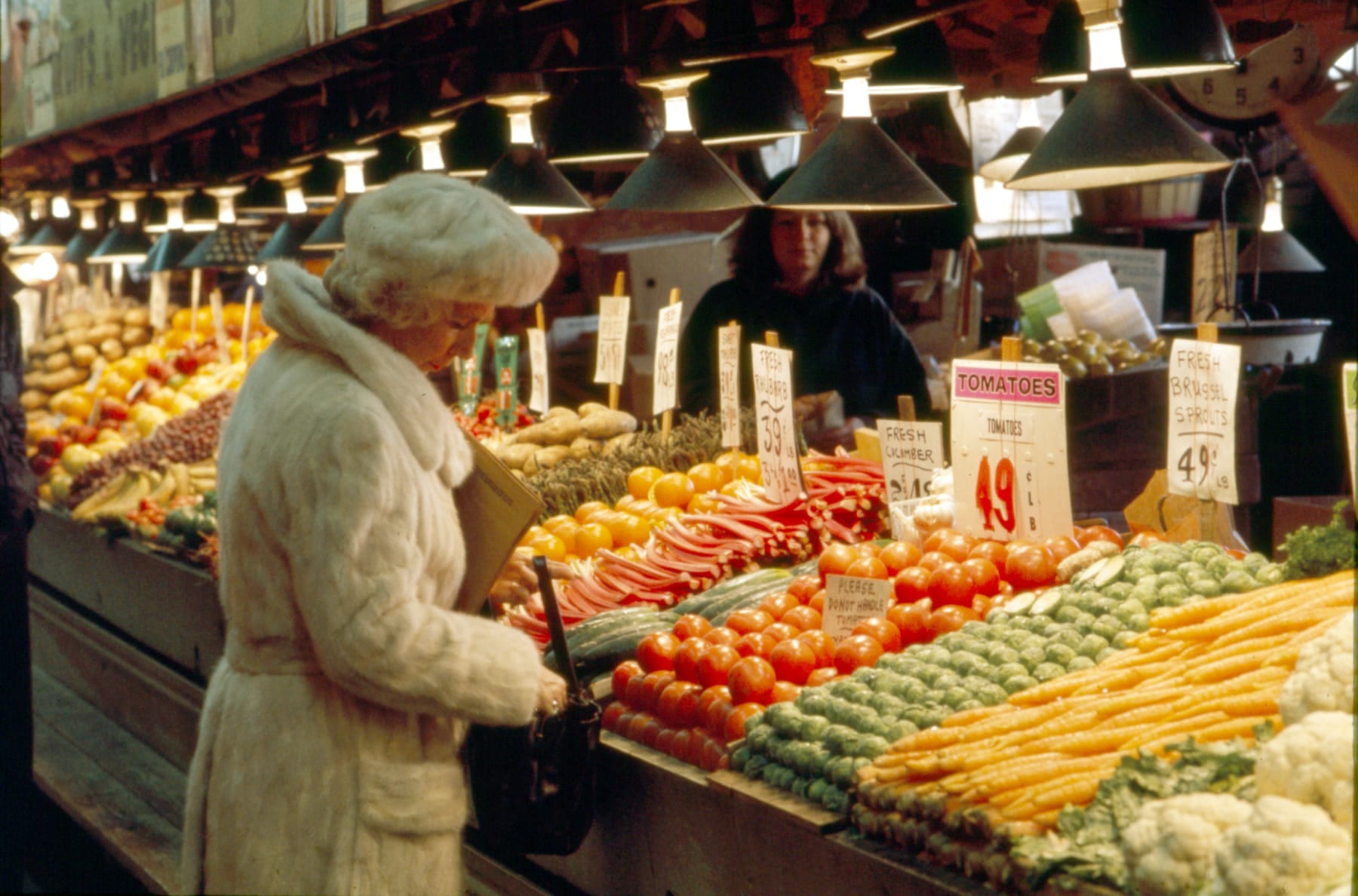
In this guide
The tents, the tokens, the card readers, the nonprofit manager with a clipboard: a Saturday farmers market looks like a fixture of the last thirty years. It is, and it isn't. The farmers market is the oldest retail idea in America, older than the country, and for most of its life it was not a movement. It was a city service, like the water main.
This is a short account of how that service was built, nearly abandoned, and rebuilt in a different legal shape. Where the record is thin, we say so.
The market lot came with the town
When Andrew Hamilton laid out Lancaster, Pennsylvania in 1730, his plan reserved a lot at the center for the town square and the lot beside it for a market, in perpetuity. Farmers traded there that year. The 1742 borough charter, issued under King George II, required "two markets in each week" on that ground "forever." The first purpose-built structure went up in 1757; the twin-towered brick market house standing there today was built in 1889. The city still owns it, and a nonprofit trust has run the day-to-day since 2004. By its own account, that makes Lancaster Central Market the oldest continuously operated public market in the country.
It is the tidiest example, not the only one. Philadelphia's story starts in the 1680s with informal trading near the river; by 1693 the local government had agreed to a formal market with a head house where Second Street crossed High Street (today's Market Street). Boston's Faneuil Hall has been a meeting place and a market space since 1742.
The common thread is who ran these places. The market was public property, open on set days and policed by a market clerk enforcing what historian Helen Tangires calls "precise rules of commercial conduct in the form of market laws." Stall rents were city revenue, and in some cities they funded poor relief. Nobody applied to a market manager. You paid the town for a stand and obeyed the ordinance.
The century of the market house
The nineteenth century was the age of the market house: a roofed municipal building where dealers rented stalls and farmers set up along the edges. Faneuil Hall Market was built between 1823 and 1826 with a million dollars of public money under Mayor Josiah Quincy. Cleveland opened its first public market in 1829, had four open-air markets by 1836 when its population was about 3,080, and built its first municipal market house in 1839.
Two buildings from the back half of that century are still in business. Lancaster's 1889 market house is one. The other is Philadelphia's Reading Terminal Market, which opened in 1892 underneath the Reading Railroad's new train shed and took in the merchants of the Butchers and Farmers' Market and the Franklin Market. By 1913 it advertised "250 specialized dealers and 100 farmers occupying the stalls."
That mix of full-time dealers and part-time farmers was the norm. A USDA Yearbook of Agriculture passage from 1909, quoted in the National Agricultural Library's local-foods exhibit, describes public markets in Baltimore, Norfolk, and Washington where dealers held the stalls and producers "occupy places along the neighboring sidewalks." The producer-only market we picture today came much later.
Cleveland's West Side Market opened in 1912, and the following year the city's superintendent of markets estimated that 75,000 Clevelanders shopped the public markets every week.
The West got its market late, for a reason any vendor will recognize. In the summer of 1907 Seattle shoppers were angry about prices and farmers about what the commission houses paid them; the market's own history says onions had gone from ten cents a pound to a dollar. On August 5 the city council set aside part of Pike Place for selling farm products from wagons. On Saturday, August 17, somewhere between six and twelve farmers pulled up and sold out by lunchtime. By 1909, according to the Seattle Municipal Archives, the market averaged 64 farmers a day and 300,000 visitors a month.
What emptied the stalls
Nothing killed the public market outright. It was outcompeted, slowly, on several fronts.
The first was the corner grocer. Tangires cites a March 1917 National Municipal League survey that counted 25,000 grocery stores in New York, 3,197 in Baltimore, and 2,575 in Cleveland: small, private, close to home, open every day. The same survey is a caution against reading the decline too fast. At least 72 cities still ran public markets in 1917, most reported their stalls rented, and a Census count the next year found 237 of them in 128 cities. The two forms of retailing coexisted for a generation.
Self-service and scale did more damage. Piggly Wiggly opened in Memphis in September 1916 and let customers take items off the shelves themselves; King Kullen followed in Queens in 1930; after the war, home refrigerators and cars carried the chains through the 1950s. Commission merchants with good rail access bought straight from farmers, and wholesale distributors with cold storage rebuilt the supply chain around the city market rather than through it.
Then the refrigerator moved into the kitchen. The Encyclopedia of Cleveland History puts it plainly: refrigeration "meant that consumers no longer had to buy fresh food each day," and suburbanization and chain supermarkets did the rest. USDA's own writers saw it early. Wells A. Sherman, in the 1926 Yearbook of Agriculture, concluded that "the farmer's retail market does not appear to be growing in importance." Twenty years later a USDA marketing research report put the balance plainly: retail farmers markets still outnumbered wholesale ones, but the wholesale markets handled the greater volume of business.
The buildings tell the rest. Cleveland's Central Market burned in December 1949; its successor, the New Central Market, was razed in 1988 for the Gateway project. The Reading Company, which owned Reading Terminal, went bankrupt in 1971, and by 1979 the market was 20 percent occupied. Pike Place survived by ballot: citizens gathered 25,000 signatures in three weeks, and on November 2, 1971 voters approved an initiative by a 3-to-2 margin that created a seven-acre historic district. A public development authority was formed in 1973 to buy and manage the buildings.
How many markets were left at the bottom? Nobody counted well. A 1978 report from USDA's Economics, Statistics, and Cooperatives Service, quoted by the National Agricultural Library, said that "although an accurate count is not available," there were an estimated 541 farmers markets in 36 states and the District of Columbia in 1976, and that nationally the number "probably approached 600." In a country this size, that is close to none.
1976: Congress puts it in writing
That same year Congress passed the Farmer-to-Consumer Direct Marketing Act, Public Law 94-463, signed October 8, 1976. It is short, and still on the books as Chapter 63 of Title 7. The purpose clause tells the Secretary of Agriculture to "initiate and coordinate a program designed to facilitate direct marketing from farmers to consumers for the mutual benefit of consumers and farmers." The definition is broader than most people expect: any marketplace "including, but not limited to, roadside stands, city markets, and vehicles used for house-to-house marketing" where farmers sell to consumers "in a manner calculated to lower the cost and increase the quality of food to such consumers while providing increased financial returns to the farmers."
In 1976 the Act did two practical things. It ordered a continuing survey of direct marketing methods in every state, run through the Economic Research Service. And it sent appropriated funds to state departments of agriculture and USDA's Extension Service to sponsor conferences, compile the laws and regulations that applied to direct sales, and provide technical assistance. That is where the state-agency staff and the paper trail came from.
Manager training came later. The 2002 farm bill amended the Act to make the survey annual and to direct the Secretary to develop programs to train market managers and extension employees, and it added a Farmers' Market Promotion Program as a new section. The 2018 farm bill repealed that section and folded the program into the Local Agriculture Market Program, but the Agricultural Marketing Service still runs it as FMPP, with a funding notice each fiscal year.
The same summer the Act passed, Barry Benepe and Bob Lewis opened New York City's first Greenmarket on July 17, 1976, under the Queensboro Bridge, as an answer to disappearing family farms and industrialized produce. GrowNYC now runs 45 year-round Greenmarkets around the city. That model, producers selling their own goods at a permitted public site run by a nonprofit, is the one most American markets follow.
The directory years
The Agricultural Marketing Service's national directory count begins in 1994 with 1,755 markets. The listings are voluntary and self-reported, so treat them as a floor rather than a census. They are still the only continuous national series.
| Year | Markets listed in the USDA directory |
|---|---|
| 1994 | 1,755 |
| 2000 | 2,863 |
| 2006 | 4,385 |
| 2010 | 6,132 |
| 2014 | 8,268 |
| 2019 | 8,771 |
Source: USDA AMS national directory counts, August 2019.
The Economic Research Service works that out to growth of nearly 7 percent a year, with a clear turn: expansion began to slow in 2011 and fell below 1 percent a year between 2016 and 2017. ERS ties the plateau to intermediated local sales, meaning grocery stores, restaurants, and distributors buying local. Our companion piece on what USDA data actually says about farmers markets today goes through the numbers.
Who runs a market now
The best snapshot of the modern market is the 2019 National Farmers Market Managers Survey, published by the National Agricultural Statistics Service in August 2020. It estimated 8,140 operating markets from a stratified sample of 10,000 in the contiguous 48 states (a different measure from the directory's 8,771 listings, so name your source when you quote either).
Of those markets, 5,979 governed themselves and 2,161 were governed by another entity. Among the self-governed, 65.6 percent were nonprofits, 21.0 percent for-profit, and 8.1 percent government entities. Where another organization governed, NASS put that body at a nonprofit 45.6 percent of the time, a municipal agency 28.0 percent, and another government entity 19.2 percent. Only 2,930 markets had a permanent structure of any kind, and 34.4 percent operated on public land or improvements granted or gifted to them.
The scale is small, too. The survey found an average of 25 vendors on a peak market day; Saturday was market day for 52.4 percent of markets, and 21 percent ran year-round. Managers were paid in 4,321 markets and volunteered in 3,162. Federal nutrition benefits were accepted at 4,076 markets, and 78.7 percent of those took SNAP.
The old market houses ended up in the same shape. Lancaster's building belongs to the city, and the Central Market Trust manages it. The Pennsylvania Convention Center bought Reading Terminal Market in 1990, and a nonprofit Reading Terminal Market Corporation was created in 1994 to run it. Pike Place's development authority is a not-for-profit public corporation. Public ownership or permission, nonprofit management, and producers who apply for a stand rather than inherit one: that is the industry now. We look at how those boards and managers make decisions in Who runs a farmers market?
What the record is good for on a Saturday
Two things carry over to the table. The split between the sidewalk farmer and the stall dealer never went away, and producer-only rules are a modern fix for a very old problem. That is why managers ask so many questions on an application; how to become a farmers market vendor covers what they will want to see.
The other is the 1976 purpose clause: lower cost and better quality for the shopper, better returns for the farmer. City councils and grant reviewers still apply that test, whether or not they know where it came from. If your market is asking a city for space or a reviewer for money, that is the sentence to quote.
To see the results in person, start with our tour of America's oldest continuously operating public markets. To shop well this Saturday, how to shop a farmers market like a regular is the shorter read.
Sources and further reading
- 1.About Lancaster Central Market · Lancaster Central Market · accessed Sep 2, 2026 · 1730 founding on Hamilton land, 1742 charter and royal decree, 1757 first structure, 1889 market house, city ownership, Central Market Trust formed 2004
- 2.Central Market: Lancaster, Pennsylvania (Great Places in America) · American Planning Association · accessed Sep 2, 2026 · Andrew Hamilton's 1730 town plan reserved an adjacent lot for a market in perpetuity; continuous operation on the same site; James H. Warner; National Register listing 1972
- 3.Market Timeline · Reading Terminal Market · accessed Sep 2, 2026 · 1680 informal markets, 1693 formal market at Second and High, 1892 opening under the Reading train shed, 1913 dealer and farmer counts, 1971 bankruptcy, 20 percent occupancy in 1979, 1990 Convention Center purchase, 1994 nonprofit corporation
- 4.Faneuil Hall · National Park Service · accessed Sep 2, 2026 · Meeting place and market space since 1742
- 5.Feeding the Cities: Public Markets and Municipal Reform in the Progressive Era · National Archives, Prologue Magazine (Helen Tangires, Spring 1997) · accessed Sep 2, 2026 · Faneuil Hall Market 1823-1826, one million dollars in public funds, Mayor Josiah Quincy; market laws and clerks; stall rents funding poor relief; March 1917 National Municipal League grocery counts and the 72 cities still running markets; commission merchants and cold storage
- 6.Markets and Market Houses · Encyclopedia of Cleveland History, Case Western Reserve University · accessed Sep 2, 2026 · 1829 first market, four markets by 1836 with 3,080 residents, 1839 municipal market house, West Side Market 1912, 75,000 weekly shoppers in 1913, refrigeration and suburbanization, 1949 fire, 1988 razing
- 7.Pike Place Market Centennial · Seattle Municipal Archives · accessed Sep 2, 2026 · Ordinance and August 17, 1907 opening; commission houses; 64 farmers a day and 300,000 visitors a month by 1909; 25,000 signatures in three weeks; 3-to-2 vote; development authority 1973
- 8.Pike Place Market History · Pike Place Market Preservation and Development Authority · accessed Sep 2, 2026 · August 5, 1907 council action; onion prices; six to twelve farmers on opening day; November 2, 1971 vote; seven-acre historic district; PDA as not-for-profit public corporation
- 9.Farmers Markets (Mailboxes, Mom and Pop Stands, and Markets: Local Foods Then and Now) · USDA National Agricultural Library · accessed Sep 2, 2026 · Quotes USDA passages verbatim: Andrews, 1909 Yearbook, on dealers and sidewalk producers; Sherman, 1926 Yearbook; Wann and others, Marketing Research Report 17 (1946); and the 1978 Economics, Statistics, and Cooperatives Service estimate of 541 markets in 36 states and D.C. for 1976
- 10.7 U.S.C. Chapter 63: Farmer-to-Consumer Direct Marketing · Office of the Law Revision Counsel, U.S. House of Representatives · accessed Sep 2, 2026 · Public Law 94-463, October 8, 1976; sections 3001 purpose and 3002 definition; section 3003 survey (a continuing survey in 1976, made annual by Public Law 107-171 in 2002); section 3004 state assistance, with the manager-training subsection added in 2002
- 11.7 U.S.C. 3005: Farmers' market and local food promotion program (repealed) · Office of the Law Revision Counsel, U.S. House of Representatives · accessed Sep 2, 2026 · Farmers' Market and Local Food Promotion Program added by Public Law 107-171 (May 13, 2002) and repealed by Public Law 115-334, section 10102(c)(5)(B) (December 20, 2018)
- 12.7 U.S.C. 1627c: Local Agriculture Market Program · Office of the Law Revision Counsel, U.S. House of Representatives · accessed Sep 2, 2026 · Added by Public Law 115-334, section 10102; subsection (d)(6) carries the farmers' market and local food promotion program
- 13.Farmers Market Promotion Program · USDA Agricultural Marketing Service · accessed Sep 2, 2026 · Program still operating under LAMP; FY26 notice of funding opportunity, applications closed June 5, 2026, and the four project types
- 14.In Season: Celebrating 50 Years of Greenmarkets · WNYC · accessed Sep 2, 2026 · First Greenmarket July 17, 1976 under the Queensboro Bridge; Barry Benepe and Bob Lewis; GrowNYC manages 45 year-round markets
- 15.America's First Supermarket at 100: How It Changed the World · Time · accessed Sep 2, 2026 · Piggly Wiggly, Memphis, September 1916; King Kullen, Queens, 1930; home refrigerators and cars sustaining supermarket growth in the 1950s
- 16.National Count of Farmers Market Directory Listings · USDA Agricultural Marketing Service · accessed Sep 2, 2026 · Year-by-year directory counts 1994-2019; listings are voluntary and self-reported
- 17.Growth in the number of U.S. farmers markets slows in recent years · USDA Economic Research Service · accessed Sep 2, 2026 · 1,755 markets in 1994 to 8,771 in 2019; nearly 7 percent annual growth; slowdown from 2011; below 1 percent between 2016 and 2017; intermediated outlets
- 18.National Farmers Market Managers 2019 Summary · USDA National Agricultural Statistics Service · accessed Sep 2, 2026 · 8,140 markets from a stratified sample of 10,000 in the contiguous 48 states; governance, legal status, property ownership, permanent structures, vendors per peak day, days and months of operation, manager pay, and nutrition program acceptance tables
Weekly newsletter
Market Dispatch
One email a week with the newest guide, what's in season, and a few things worth knowing before market day.
Email subscriptions are not open yet. Read every new story through our free RSS feed.
Follow Market Dispatch via RSS →Keep reading
Analysis: What USDA Data Actually Says About Farmers Markets Today
Four USDA datasets count farmers markets in four different ways, and none of them shows the boom still running. Here are the numbers as published, what each one measures, and what they suggest for a vendor deciding where to sell.
· 9 min read
How to Find the Right Farmers Market for What You Sell
The USDA directory alone lists more than 7,000 farmers markets. Here is where to look, what a listing cannot tell you, and how two visits as a shopper and one conversation with the manager reveal whether a market actually needs what you make.
· 8 min read